
THCA Guides
Live Resin vs Liquid Diamonds vs Live Sugar: What Is the Difference?
Aug
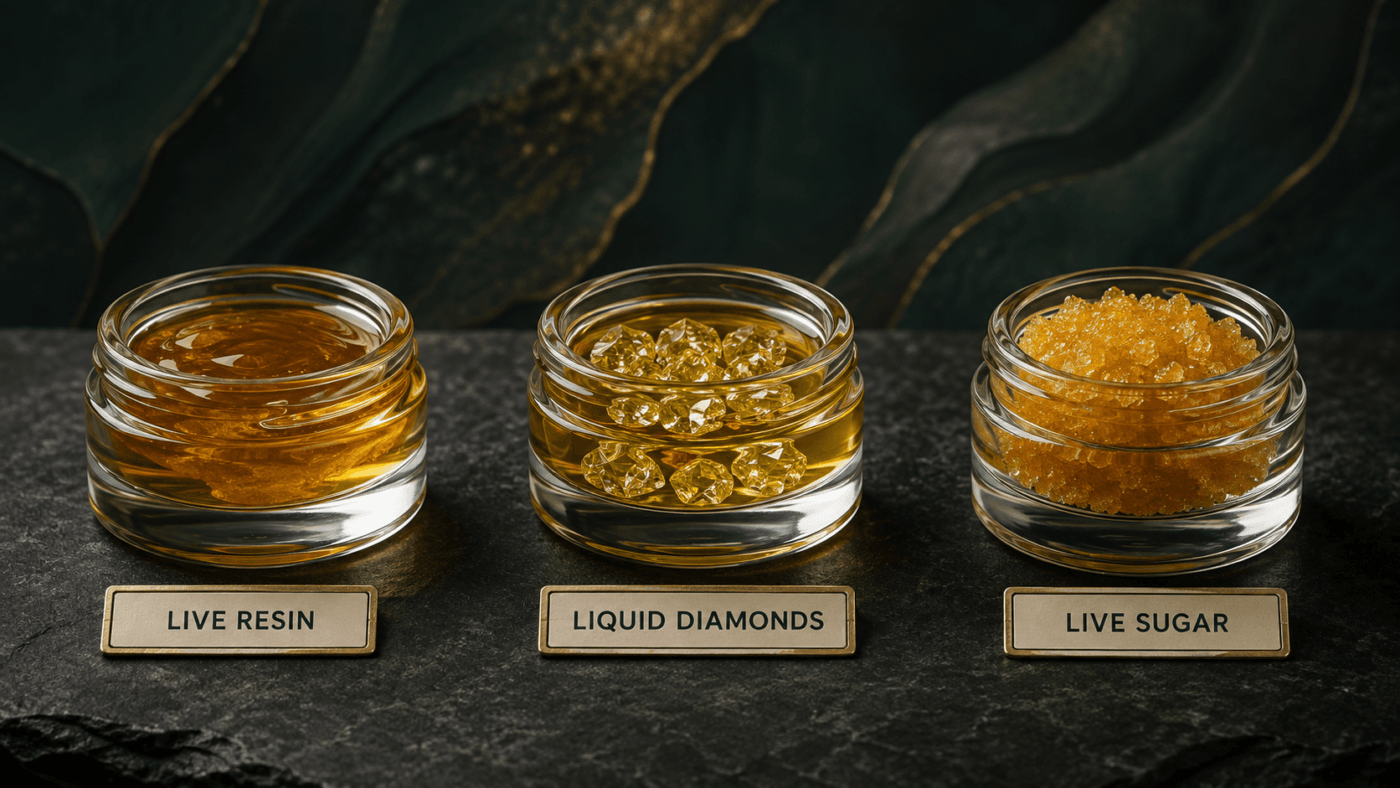
Live resin vs liquid diamonds vs live sugar can sound like a comparison of three fixed recipes, but these names are better understood as common product-style descriptions. They may indicate how a manufacturer handled the source material, refined the extract or formulated a vape. They do not, by themselves, guarantee a particular ingredient list, cannabinoid percentage, terpene level, flavor or experience.
This guide explains the usual meaning of each term, the differences that may matter on a label or Certificate of Analysis (COA), and how adults 21 and older can compare current Hidden Hills products more carefully. Always use the exact package and batch documentation as the final authority.
Quick Comparison
| Term | Common emphasis | What the name does not guarantee | What to verify |
|---|---|---|---|
| Live resin | Extract associated with fresh or fresh-frozen plant material and preservation of aromatic compounds | A fixed terpene percentage, “full-spectrum” composition, potency or solvent-free processing | Ingredients, cannabinoid and terpene results, residual-solvent panel, batch number |
| Liquid diamonds | A cannabinoid-rich refined or crystalline fraction formulated into a liquid suitable for a finished product | A universal formula, the highest potency, a specific cannabinoid ratio or the absence of added terpenes | Dominant cannabinoids, total THC calculation, ingredients, terpene source and batch COA |
| Live sugar | A “sugar”-style or live-material concentrate description, sometimes used for a formulated product family | That the product contains table sugar, a specific texture inside a vape or a standardized manufacturing method | Product format, ingredients, cannabinoids, terpenes, testing and manufacturer description |
The practical lesson is simple: compare the actual formulation and laboratory results. A product name is a starting point, not the complete specification.
What Is Live Resin?
Live resin commonly refers to a cannabis extract made with fresh or fresh-frozen plant material rather than plant material that has gone through a conventional drying and curing process. The goal is generally to retain more of the volatile aromatic compounds present near harvest. Exact freezing, extraction, refinement and formulation methods vary by manufacturer.
The word live describes the handling of the source material; it does not mean the product is alive. The word resin refers broadly to cannabinoid- and terpene-containing material collected or extracted from the plant. Neither word establishes a required potency.
In a jar, live resin may appear saucy, viscous, granular or otherwise textured. In a vape, however, a manufacturer must create a formulation that functions with the hardware. The oil inside an integrated vaporizer may therefore look different from a concentrate intended for another product format.
What live resin may emphasize
- Fresh or fresh-frozen source material
- Aromatic and terpene characteristics
- A formulation intended to reflect the source material’s profile
Do not assume that every live resin is “full spectrum,” solvent-free or higher in terpenes. Check the product description, ingredient list and batch report for those details.
What Are Liquid Diamonds?
Liquid diamonds is a commercial term commonly associated with highly refined, cannabinoid-rich crystalline material—often described in the market as THCA diamonds—that has been converted or blended into a form suitable for a finished product. Despite the name, it contains no gemstones.
Crystalline cannabinoid material alone is not automatically a ready-to-use vape oil. A finished liquid-diamond vape may include a cannabinoid-rich fraction, terpenes or other ingredients disclosed by the manufacturer. Formulations can differ substantially, so the words “liquid diamonds” do not reveal the complete composition.
Do not use the name as proof that a product is stronger than every live resin or live sugar option. Compare the measured cannabinoid values on the correct COA. If THCA and delta-9 THC are listed separately, remember that heating can convert THCA into THC and that conversion is not perfectly one-to-one by weight. Our THCA vs THC guide explains that distinction.
What liquid diamonds may emphasize
- A refined, cannabinoid-rich component
- Consistency of the principal cannabinoid fraction
- A formulation designed for a particular product or vape platform
The final product may be very different from visible crystals in a concentrate container. The package and COA should be used to identify the cannabinoids and other declared ingredients actually present.
What Is Live Sugar?
Live sugar usually refers to a concentrate with a grainy, sugar-like appearance or to a product family inspired by that style and made from live-material inputs. The term “sugar” describes texture or product positioning; it does not mean that ordinary sugar has been added.
As with live resin, the exact process varies. A live sugar concentrate may contain small cannabinoid crystals suspended in a terpene-rich portion. A live sugar vape, on the other hand, must be formulated to move through its hardware. You should not expect the oil in every device to display a visible sugar texture.
What live sugar may emphasize
- Fresh or fresh-frozen source material
- A sugar-style concentrate or product-family profile
- A balance between a cannabinoid-rich fraction and aromatic compounds
Those are common descriptions rather than a universal recipe. Confirm what a particular Hidden Hills listing and package actually say.
These Names Are Not Potency Grades
Live resin, liquid diamonds and live sugar are not official levels on a single quality scale. One is not automatically “best,” and a name alone cannot predict how an individual will respond.
Potency is measured through laboratory analysis. Relevant values may include THCA, delta-9 THC, CBD and other cannabinoids. Some reports also provide a calculated total THC value. A product’s listed oil amount—such as 1G, 2G or 3G—describes quantity, not concentration. See our 1G vs 2G vs 3G disposable vape guide for the difference.
Terpenes also should not be treated as a simple quality score. A higher total terpene percentage does not guarantee better flavor, better hardware performance or a preferred experience. Look at the individual compounds, the complete formulation and the batch results together.
Why Formulations Can Differ
Cannabis manufacturing may involve extraction, post-processing, infusion, packaging and labeling. Manufacturers can use different starting material, equipment, temperatures, pressures, solvents or mechanical methods. Refinement can separate or concentrate particular components, and formulation can recombine selected fractions for a finished product.
That means two products using the same broad term can still have different:
- Cannabinoid concentrations and ratios
- Terpene profiles and sources
- Ingredient lists
- Viscosity and hardware compatibility
- Flavor and aroma profiles
- Batch test results
Do not assume that a product made by one company defines the term for every other company. Even products within the same family can change between batches or flavors.
How to Compare the Label and Ingredient List
Start with the product page, but use the physical package when the two differ. Packaging is tied to the item in hand and may contain batch-specific details.
- Confirm the product format. Determine whether it is an integrated disposable, a cartridge or another concentrate product.
- Read the ingredient list. Look for the stated extract, cannabinoids, terpenes and any other ingredients.
- Identify the batch or lot. This is the key for matching a COA to the item.
- Check the net quantity. Do not confuse grams of oil with cannabinoid percentage.
- Review hardware instructions. Confirm whether the device is rechargeable, which connector it uses and whether activation is automatic or button-controlled.
- Read required warnings. Follow age, storage, state-law and safety statements on the package.
Flavor or strain-themed names may describe taste, aroma or a desired profile. They do not guarantee a particular ingredient, effect or potency.
How to Compare the Certificate of Analysis
Use the Hidden Hills Certificates of Analysis section and match the report to the product’s batch or lot identifier whenever possible. Our complete guide to reading a cannabis COA explains the process in more detail.
1. Confirm the identity
Check the product name, product type, batch or lot number, sample dates and laboratory information. A report for source flower, a different flavor or another production batch is not interchangeable with the finished product’s report.
2. Review cannabinoids
Compare THCA, delta-9 THC, CBD and any other reported cannabinoids. Note the units—percent by weight and milligrams per gram are related but are not written the same way. Do not compare numbers unless the units and product formats are understood.
3. Review terpenes when reported
A terpene panel can show total and individual compounds. It can help document a batch’s measured aromatic profile, but it does not independently prove the source of the terpenes or predict an individual experience.
4. Check safety panels
Depending on the product and applicable requirements, relevant panels can include residual solvents and processing chemicals, pesticides, heavy metals, microbial impurities, mycotoxins and foreign material. Do not treat a cannabinoid-only result as a substitute for every safety panel.
5. Verify pass/fail and report status
Look for results for each relevant analyte, not just a prominent “pass” statement. Confirm that the report is final and that the identifiers match the package. Contact support if the match is unclear.
Live Resin vs Live Rosin
Live resin and live rosin are different common terms. Live resin is generally associated with solvent-based extraction from fresh or fresh-frozen material. Live rosin is generally associated with mechanical separation using pressure, heat or cold rather than chemical solvents.
However, the exact manufacturing and post-processing steps still matter. Do not infer “solvent-free” from a live resin label. Likewise, a process description does not replace batch testing or an ingredient list.
Why Vape Hardware Matters
A vape formulation needs to work with the device’s heating element, airflow, power output and oil-delivery system. Oil that is too thick, too thin or incompatible with the hardware may not perform as intended. This is one reason a concentrate’s appearance in a jar should not be used to predict its appearance or behavior inside a vape.
Do not open, refill, dilute or modify a sealed device. Only charge hardware when the product page or manufacturer instructions confirm that it is rechargeable. Use compatible equipment and never force a connector into a charging port.
If you are deciding between an integrated device and a separate cartridge, read our vape cartridge vs disposable vape guide.
How to Choose Between the Three
Instead of asking which name is universally better, compare the features that matter for the specific product:
- Product format: disposable, cartridge or another form
- Declared ingredients: what the manufacturer says is in the finished product
- Batch identity: whether the package matches an available COA
- Cannabinoid profile: measured values and units, not slogans
- Terpene panel: individual and total results when provided
- Safety testing: applicable contaminant and processing panels
- Hardware: capacity, operation and charging instructions
- Availability: the exact flavor or strain option currently in stock
Adults who prioritize a product associated with fresh-frozen source material may begin by comparing live resin and live sugar listings. Adults who prioritize a cannabinoid-rich refined fraction may begin with liquid-diamond listings. In either case, the specific label and COA should decide whether the product fits the comparison—not the family name alone.
Warning Signs to Avoid
- A product name without a clear ingredient list
- No batch or lot identifier on the package
- A COA for another product, flavor or production batch
- A source-material report presented as the finished-product report
- Potency claims that do not match the laboratory result
- “Solvent-free” or “full-spectrum” claims without supporting product information
- A safety claim based only on cannabinoid or terpene testing
- Damaged, leaking, swollen or unusually hot hardware
Stop using or charging a device that leaks, swells, becomes unusually hot, produces an unusual odor or shows visible damage. Do not disassemble or modify it.
Storage and Disposal
Store a vape upright where practical in a cool, dry place away from excessive heat, direct sunlight and open flames. Keep all products securely away from children and pets. Do not leave disposable hardware in a hot vehicle.
Do not puncture, crush, burn or disassemble a device. Follow local battery and electronic-waste requirements when disposing of empty or unusable hardware.
Explore Hidden Hills Vape Options
Browse the main Hidden Hills Vapes collection or compare these categories:
Related product families include:
- 2G Live Resin Fire Blends
- 2G Liquid Diamond Night Night Blends
- 3G Live Sugar Quadra Bar
- 3G Quadra Bar
Inventory, variants and product descriptions may change. Confirm the exact selection in your cart before ordering.
Frequently Asked Questions
Is live resin stronger than liquid diamonds?
Not necessarily. These names describe product styles, not fixed potency levels. Compare the cannabinoid values and units on batch-matched laboratory reports.
Are liquid diamonds always pure THCA?
No. A finished liquid-diamond product may contain a refined cannabinoid fraction plus terpenes or other declared ingredients. Review the label and COA for the actual composition.
Does live sugar contain sugar?
The term normally describes a sugar-like texture or product style, not the addition of table sugar. Check the ingredient list rather than relying on the name.
Is live sugar the same as live resin?
They may share an association with fresh or fresh-frozen source material, but the terms can emphasize different textures, fractions or formulations. Manufacturers do not all use one standardized recipe.
Is live resin the same as live rosin?
No. Live resin is commonly associated with solvent-based extraction, while live rosin is commonly associated with mechanical separation using pressure, heat or cold. Verify the exact process stated for the product.
Do “diamonds” mean the product contains gemstones?
No. The word refers to crystalline cannabinoid material or a product inspired by that refined fraction.
Does live resin always contain more terpenes?
No. Live resin often emphasizes aromatic compounds, but actual terpene results vary by material, process, formulation and batch. Use a terpene panel when available.
Are these products solvent-free?
Do not assume so. Extraction and post-processing methods differ. Review the manufacturer description and applicable residual-solvent results.
Can one COA cover every flavor in a product family?
Do not assume that reports are interchangeable. Match the product, flavor, batch or lot and other identifiers as closely as possible.
Does a 3G live sugar vape have higher potency than a 2G live resin vape?
Not because of the gram amount. Grams describe the listed oil quantity; potency is expressed through measured cannabinoid concentration.
Which option is best for beginners?
There is no universal answer. Product strength, formulation, hardware and individual response vary. Adults should review the label and COA, follow package directions and avoid assuming that a product name predicts effects.
What should I do if my device arrives damaged?
Do not use or charge it. Keep the packaging, photograph the device, label and batch details, and contact Hidden Hills support.
Continue learning: Explore all Hidden Hills THCA guides covering flower, vapes, prerolls, storage and laboratory reports.
Sources and Important Notice
California’s Department of Cannabis Control explains that manufacturing can include cannabinoid extraction, post-processing, infusion, packaging and labeling, and that permitted methods depend on the manufacturing activity. It also identifies cannabinoids, terpenes, residual solvents and processing chemicals, pesticides, heavy metals, microbial impurities and other categories among regulated laboratory tests. The National Institute of Standards and Technology develops cannabis measurement science to improve the reliability and comparability of laboratory results.
- California Department of Cannabis Control: Manufacturing
- California Department of Cannabis Control: Manufacturing License Types
- California Department of Cannabis Control: Testing Laboratories
- National Institute of Standards and Technology: Cannabis Quality Assurance Program
Adults 21+ only. This article is general product education, not medical or legal advice. Laws governing hemp-derived and cannabis products vary and may change. Hidden Hills ships within the United States only where permitted; review the shipping policy and your current state and local rules before ordering. Do not drive or operate machinery while impaired. Keep products away from children and pets.
