
THCA Guides
How to Read a Cannabis Certificate of Analysis (COA)
Aug
Learning how to read a cannabis COA helps you verify what was tested instead of relying on a product name or headline potency number. A Certificate of Analysis, or COA, is a laboratory report for a submitted sample. It may show cannabinoids, contaminant findings, dates, identifiers and reporting limits.
A COA is most useful when it matches the exact product and batch. It is not a universal guarantee for every product with the same name and cannot predict individual response. This guide explains the fields, calculations and warning signs to check.
What Is a Cannabis Certificate of Analysis?
A cannabis COA records laboratory findings for a sample received and tested by a laboratory. Depending on the product, jurisdiction and requested testing scope, the report may include:
- Cannabinoid identity and concentration
- Terpene results
- Pesticide screening
- Heavy-metal testing
- Residual-solvent or processing-chemical testing
- Microbial-impurity and mycotoxin testing
- Moisture content or water activity
- Foreign-material findings
Not every report contains every panel. A cannabinoid-only report should not be treated as proof that pesticides, metals, microorganisms or solvents were also tested. The California Department of Cannabis Control requires a defined set of testing categories for products in its regulated market, but hemp requirements and standards can vary by product type and jurisdiction.
Step 1: Match the COA to the Product and Batch
Before interpreting any number, confirm that the report belongs to the product you are evaluating. Compare the COA with the package or product label and look for:
- Product or sample name
- Batch, lot or production identifier
- Sample type or matrix, such as flower, extract or edible
- Client or manufacturer name
- Sample received, test and report dates
- Package or serving information, when applicable
The batch or lot number is especially important. Two packages with the same strain or flavor name may come from separate production batches and have different results. A report for flower should not be used for a vape formulated from an extract, and a report for one edible flavor or batch should not be assumed to cover another.
Visit the Hidden Hills Certificates of Analysis page and match the available report to the identifier on the selected package whenever possible. If the report is unreadable or the identifiers do not match, contact Hidden Hills support before treating it as the correct document.
Step 2: Identify the Laboratory and Report Status
A complete COA should identify the laboratory and normally provide contact information, an address, a report number and the name or signature of an authorized reviewer. It may also display a laboratory license or accreditation number.
Check whether the report is labeled final, amended, revised or preliminary. A preliminary result may change after review. If a QR code or verification link is present, use it to compare the hosted report with the copy you received. Be cautious when only a cropped screenshot is available, because omitted pages may contain qualifications, failed results or additional panels.
Step 3: Read the Cannabinoid Panel
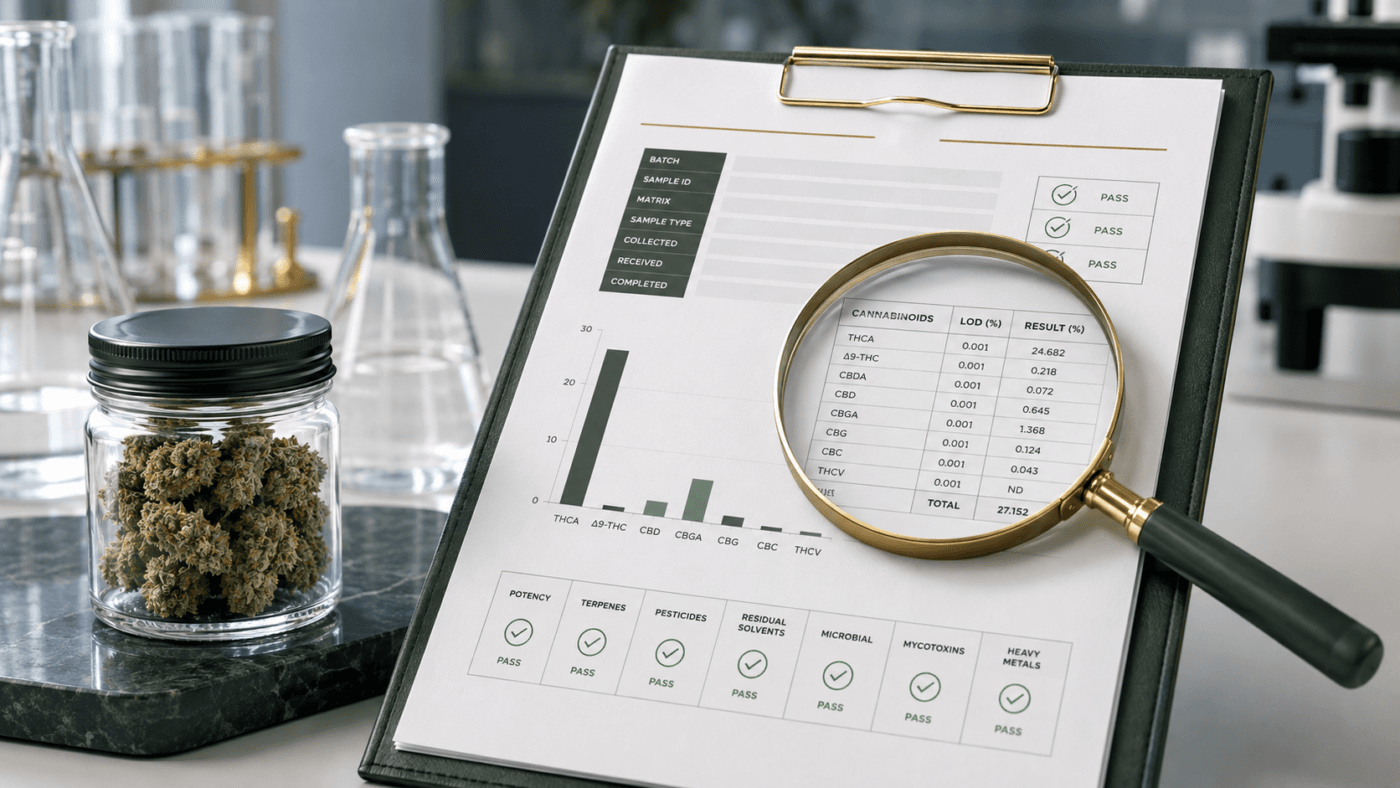
The cannabinoid table may list THCA, delta-9 THC, CBDA, CBD, CBG and other compounds separately. Each row should pair an analyte with a result and unit. Read the column headings carefully rather than assuming every number is a percentage.
Common units include:
- Percent by mass: the reported portion of the tested sample by weight
- Milligrams per gram (mg/g): milligrams of an analyte per gram of sample
- Milligrams per unit or package: often used for a finished edible or another portioned product
On the same mass basis, 1% equals 10 mg/g; 20% therefore corresponds to 200 mg/g. Do not apply that conversion across different reporting bases without the necessary product weight and calculation details.
A larger cannabinoid number does not automatically mean better product quality, and it does not predict an individual’s experience. To understand the compounds themselves, read What Is THCA? and THCA vs THC: What Is the Difference?.
Understand the Total THC Calculation
THCA and delta-9 THC may appear as separate results because THCA can convert into delta-9 THC when heated through decarboxylation. A commonly used calculation estimates total available THC as:
Total THC = delta-9 THC + (THCA × 0.877)
The 0.877 factor accounts for the molecular-weight change associated with conversion. The USDA explains that hemp testing must account for the potential conversion of THCA to THC and report total available THC. Use the formula only when the THCA and delta-9 THC figures use compatible units and the report does not already provide its own calculated total.
Do not add raw THCA and delta-9 THC percentages without the conversion factor. Also check whether a laboratory labels its value “Total THC,” “Potential THC” or something similar and whether its notes define the calculation.
Step 4: Interpret ND, LOD, LOQ and Reporting Limits
COAs often use abbreviations to explain results near the laboratory’s measurement limits:
- ND: usually means not detected above the stated detection limit
- LOD: limit of detection, the lowest level the method can reliably distinguish from no signal
- LOQ: limit of quantitation, the lowest level the method can quantify with the laboratory’s stated performance
- <LOQ: the analyte may have been detected, but below the level at which a reliable numeric amount is reported
Read the report legend because labels may differ. “Not detected” does not necessarily mean absolute zero; it usually means the analyte was not found at or above the method’s reporting threshold.
Step 5: Review Every Contaminant Panel
Contaminant tables commonly show the analyte tested, the measured result, an action level and a pass-or-fail finding. Review each panel that applies to the product rather than stopping after the cannabinoid page.
Pesticides
Look for the full analyte list, results, reporting units and action levels. A “Pass” normally means the tested analytes met the applicable thresholds for that report; it does not establish that every chemical in existence was screened.
Heavy metals
This panel may include lead, cadmium, arsenic and mercury, depending on the testing program. Confirm which metals were included and whether the sample passed the applicable limits.
Residual solvents and processing chemicals
This panel is especially relevant to extracts and formulated vape oils. It may list solvents used or potentially introduced during processing. A flower COA and a vape COA may therefore have different testing needs.
Microbial impurities and mycotoxins
These panels may address specified microorganisms, yeast and mold measurements or toxins produced by certain fungi. Review the actual test list and status rather than relying on a general “microbial tested” statement.
Moisture, water activity and foreign material
Flower reports may include moisture content, water activity and foreign-material findings. Moisture percentage and water activity are not interchangeable. Each describes a different property and should be interpreted using the report’s method and applicable standard.
Step 6: Read Pass, Fail and Action Levels Correctly
An action level is a threshold used to evaluate a result under a particular testing rule or specification. Results may be reported in parts per million, micrograms per gram, colony-forming units or another unit appropriate to the analyte.
Always compare the result and action level using the same units. A result marked “Pass” applies only to the sample, analytes and criteria covered by that report. Thresholds may differ by jurisdiction, product matrix and date, so a pass under one program should not be automatically substituted for another program’s requirements.
If one page says “Pass” but an analyte table shows a result above its listed action level, pause and ask the laboratory or seller for clarification. Do not try to resolve an apparent contradiction by ignoring one page.
Step 7: Treat Terpene Results as Descriptive Data
A terpene panel may list compounds such as myrcene, limonene, beta-caryophyllene or pinene. Results can help describe the tested sample’s aromatic profile, but terpene testing is not always included and does not replace contaminant testing.
A strain-themed name or terpene percentage does not guarantee taste, effects or how a person will respond. Confirm whether the table reports individual terpenes, a calculated total and the same sample identifier as the rest of the COA.
Consider the Sample Matrix and Measurement Uncertainty
Laboratory methods are validated for particular sample types, often called matrices. Flower, extract, vape oil and finished edibles have different preparation requirements. Some COAs also report measurement uncertainty or a result range. Small differences between reports may not be meaningful when uncertainty, sampling variation and moisture basis are considered. The COA remains a snapshot of the submitted sample and batch.
How COAs Differ by Product Format
| Product | Important fields to confirm | Common comparison mistake |
|---|---|---|
| Flower | Strain, batch, cannabinoid basis, moisture or water activity and applicable contaminant panels | Using one harvest or batch report for another package |
| Vape | Oil or extract matrix, batch, cannabinoids, ingredients and relevant solvent, pesticide, metal and microbial panels | Using the source-flower COA as the finished vape COA |
| Edible | Finished-product matrix, serving or package basis, batch and applicable contaminant findings | Confusing mg per serving with mg per package |
| Preroll | Batch, whether it is regular or infused, sample matrix and matching cannabinoid and contaminant panels | Assuming a flower report covers added concentrate or other ingredients |
Compare the current flower, vapes, prerolls and edibles collections by their own product-specific documentation. For a format comparison, see THCA Flower vs Vapes. Flower shoppers can also use How to Choose THCA Flower.
COA Warning Signs
Pause and request clarification if you find any of these problems:
- No batch, lot or sample identifier
- A product or matrix that does not match the package
- No laboratory name, report number or test date
- An unreadable scan, cropped screenshot or missing pages
- A preliminary report presented as final
- Units that change between the result and action-level columns
- A cannabinoid-only panel described as complete safety testing
- A QR code that leads to a different product or batch
- Totals that cannot be reconciled with the listed components or notes
- A pass-or-fail summary that conflicts with the detailed results
A 60-Second COA Checklist
- Match: Confirm the product, batch and sample matrix.
- Date: Check when the sample was received, tested and reported.
- Lab: Identify the laboratory, report number and final status.
- Units: Determine whether results use percent, mg/g or mg per unit.
- Cannabinoids: Read THCA and delta-9 THC separately and verify any total calculation.
- Limits: Review the legend for ND, LOD, LOQ and other qualifiers.
- Panels: Confirm which contaminant categories were actually tested.
- Status: Compare every detailed finding with its action level and pass-or-fail result.
- Completeness: Make sure all pages are present and readable.
- Questions: Contact support when any identifier or finding cannot be matched confidently.
Frequently Asked Questions
What does COA stand for in cannabis?
COA stands for Certificate of Analysis. It is a laboratory report describing the tests and results for a submitted sample.
Does a COA prove that a product is safe?
A COA shows findings for the sample and panels tested. It does not prove that every possible contaminant was tested, guarantee every package is identical or establish that a product is risk-free.
How do I know whether a COA matches my product?
Compare the product name, batch or lot number, sample matrix and other identifiers on the report with the package. A matching batch is more meaningful than a matching strain or flavor name alone.
What does ND mean on a cannabis COA?
ND usually means the analyte was not detected at or above the method’s stated detection or reporting limit. Read the report legend because abbreviations can vary.
Is ND the same as zero?
Not necessarily. It generally means the method did not detect the analyte above a defined threshold; it is not always a claim of absolute absence.
What is the difference between LOD and LOQ?
LOD is the lowest level a method can reliably detect. LOQ is the lowest level it can quantify with its stated performance. A value below LOQ may be detectable without being reliably quantified.
How is total THC calculated?
A common formula is delta-9 THC + (THCA × 0.877). Use compatible units and check whether the laboratory already reports a calculated total.
Does 1% equal 10 mg/g?
Yes, when both values are expressed on the same mass basis: 1% by mass equals 10 milligrams per gram. That conversion does not automatically apply to milligrams per serving or package.
What should I do if I cannot find the correct COA?
Retain the package and batch information, then contact the seller before relying on a report for another product. Hidden Hills customers can use the contact page for assistance.
Review Documentation Before Ordering
Use the Certificates of Analysis section together with the selected product page and package label. Visit Hidden Hills to review current listings, and check the shipping policy and applicable destination rules before ordering.
Continue learning: Explore all Hidden Hills THCA guides covering flower, vapes, prerolls, storage and laboratory reports.
References and Further Reading
- USDA Agricultural Marketing Service: Hemp Frequently Asked Questions
- USDA: North Dakota Hemp Plan and Total THC Calculation
- California Department of Cannabis Control: Testing Laboratories
- California Department of Cannabis Control: Pesticide Testing Final Text
- NIST: Cannabis Laboratory Quality Assurance Program Exercise 3
- NIST: Cannabis Laboratory Quality Assurance Program 2022
This guide is provided for general educational purposes and is not medical or legal advice. A COA applies to the tested sample and reported scope; it does not guarantee individual effects or establish legality in every jurisdiction. Hidden Hills products are intended only for adults age 21 and older where permitted. Availability and shipping restrictions may vary by destination.
